
Meticulously handcrafted in the Himalayas

OUR STORY.

A black background image with white chalk-like diagram of a violin's outline and measurements, including horizontal and vertical lines with arrows, and dotted lines indicating specific measurements.
A white spray-painted cross symbol on a black background.

“We walked always in beauty, it seemed to me…. We did not often speak. The place spoke for us and was a kind of speech.”

White chalk lines on black chalkboard
Black and white photo of a densely packed residential area with multiple flat-roofed buildings, some with small terraces, and a few trees scattered throughout. The image captures a cloudy sky overhead.

During the early months of 2010, in a small town in the foothills of the Himalayas, a few young locals became friends with a luthier from Tennessee named Dave.

A white chalk handwriting-style diagram showing a straight line measuring 16.1 inches across, with a black background.
A young man playing guitar and singing to a group of friends gathered around a candlelit table at night.

We spent much of our time making music and trading stories.

Technical schematic drawing of a ramp with proportionate support structures underneath, depicted in white lines on a black background.

Before long, we decided to try making a few instruments. We went down to the local wood market to look for materials and found out that you couldn’t buy lumber — you had to buy the whole log.

A vertical white line on a black background, appearing textured and uneven.
Close-up of a white paintbrush stroke on a black background.

We went shopping for materials for four guitars and came back with enough for forty.

An industrial workspace with a concrete and brick wall, a large machine with a circular opening, and bags of raw material stored on top. Various tools and equipment are scattered around, with a wooden table and chairs near the bottom right.
Two men working in a sawmill cutting a thick log of wood on a large saw machine.
A vintage bicycle leaning against a wooden bench in a warehouse with a background of stacked logs.
Vertical white streak on black background

Those first few were built entirely with hand tools on the kitchen table - just for fun, just for us. But after sharing photos of our handiwork on a makeshift website, we had people contacting us to see if the guitars were for sale. In a few we had booked ten custom orders and were thrust into the realm of guitar-making entrepreneurship. We rented an old rundown storefront and transformed it into a fully-equipped workshop where we devoted ourselves to honing our skills and refining our craft. Our first several orders were for friends and family, and they were exceedingly patient and gracious, as we did our best to deliver the most responsive, beautiful instruments we could.

Line drawing of an acoustic guitar.
Black and white technical drawing of a long, straight bolt with measurements and labels.
Our old, weathered brick building with a rusted metal door partially open and a window with cracked glass and a green frame. Our shop before renovations.
Our lutherie shop, after renovations. A small, brick building with metal roof and a motorcycle passing in front.

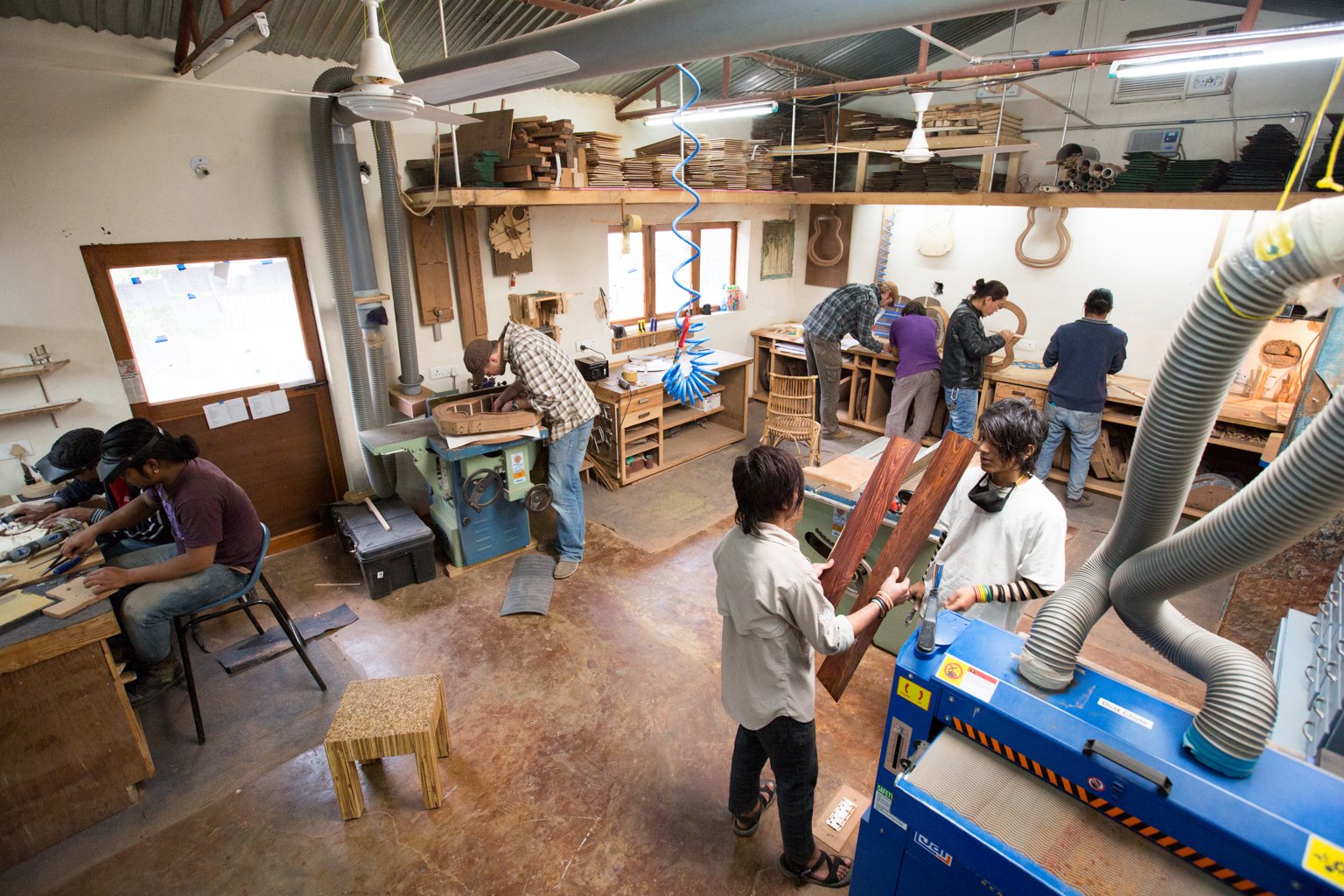
So we rented a rundown storefront, built out a woodworking shop inside and began to train intensively together in the art of building world-class custom guitars.

A vertical white streak or line on a black background.
Our shop on day one. An abandoned, dusty room with peeling blue paint on walls, cluttered with scattered debris. The room has a corrugated metal roof with sunlight streaming through gaps, and a worn green door partially open.
Making guitars. Our craftsmen working on various projects in our busy little workshop, with machinery, tonewood, and tools.

Early on, each one was designed for the client from the ground up. Each was a labor of love, involving dozens of hours of design work, with construction taking 150 man hours or more.

It was a great education in guitar making and design, a great way to make our customers happy with completely unique, once-in-a-lifetime instruments. While this approach wasn’t particularly lucrative, it sustained a dozen builders for over a decade.

A vertical white line.
A technical drawing of a mechanical assembly, including a threaded bolt, washer, and a square nut with a central hole, shown in white lines on a black background.
A vertical white line with uneven edges on a black background.
Two men working together on the internal bracing of a wooden guitar body on a workbench in a workshop.
A person with glasses is working on a woodworking project, sanding or shaping a wooden piece mounted in a blue work clamp.
Hands chiseling wood on a workbench with wood shavings and sawdust.

Five years in, Dave’s family was deported from the country without warning or due process. Despite this setback, the local team remained resilient and continued to lead the company through the next chapter, while Dave & family filed a lawsuit petitioning for the right to return. This was a challenging time, but it was also a great triumph, as the the team persevered and kept building faithfully right up until the early months of 2020.

The Covid-19 pandemic added another layer of difficulty, but despite the odds, Dave was eventually able to return to India and reunite with the original team. Today, we are focused on our favourite three designs and remain committed building high-quality instruments while supporting one another through thick and thin…as  the

Dehradun

Guitar

Company

A black and white illustration of a human brain with labeled parts.
White chalk lines with arrows showing a measurement of 4.25 inches on a black background.
A vertical black and white abstract drawing with a curved white line running through the center.
A close-up of a white candle wick against a black background.
White painted cross or plus sign on a black background.
Black and white photograph of a string of triangular flags hanging diagonally across the image, against a plain sky.

DESIGN

It may be that when we no longer know what to do we have come to our real work, and that when we no longer know which way to go we have come to our real journey. The mind that is not baffled is not employed. The impeded stream is the one that sings.

Sketch of a foot spa machine with rollers and water basin.

Since almost all our instruments were custom designs, we tried just about everything at least once…from Spanish-style nylon string guitars, to electrics, to 12-strings, a 10-string baritone, modern fingerstyle cutaway SJs, banjo-killer dreadnoughts, and 12-fret parlor guitars. We’ve done Laskin bevels, Ryan bevels, low-profile bevels, Manzer wedges, intricate inlays all up and down fretboards and bodies, hand-rubbed sunbursts, sprayed sunbursts, blue ocean bursts, elevated pickguards, multi-scale fretboards, stereo output, midi-compatible pickups with 7 outputs…honestly, in terms of design and function, we’ve probably done too many things.

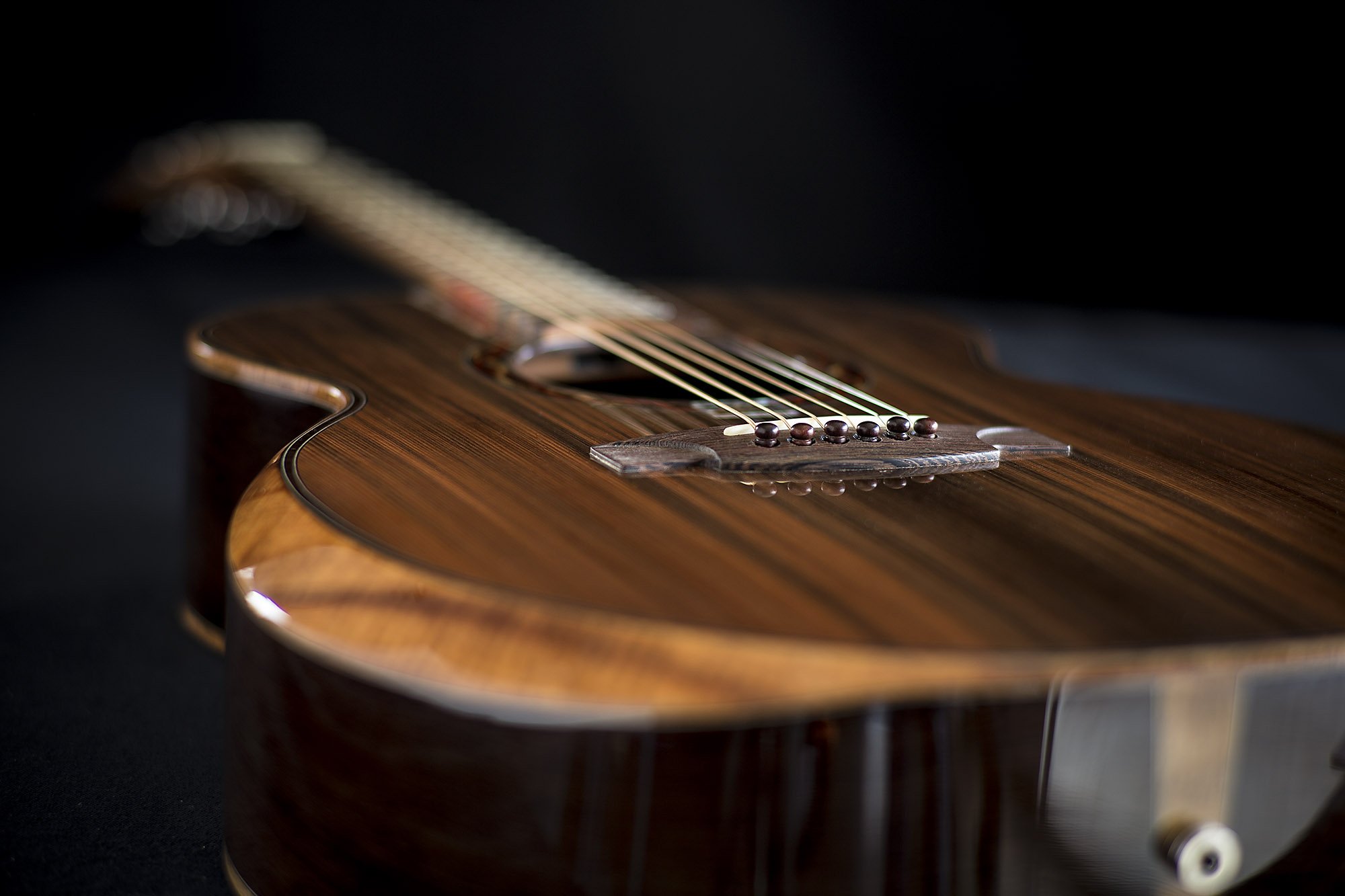
Close-up of a wooden acoustic guitar with intricate inlays on the fretboard, a decorative rosette around the sound hole, and the brand name 'Lowden' visible on the fretboard.
Close-up of a wooden acoustic guitar on a dark background.
Close-up of a modern acoustic guitar with a light-colored wooden body, black pickguard, and cutaway, against a dark background.
Close-up of an acoustic guitar with a wooden body and six strings, set against a dark background.
A long, vertical, thin white line on a black background.
White laser level device and scale on black background.
This is a black and white diagram of a straight metal nail showing its length measurement, 174 mm, and a width of 6 mm.

The steel string acoustic guitar presents a myriad of challenges, because you have so much stress acting on such thin structures. In fact, the lighter you build those structures, the more resonant the instrument. So if you want to make a truly responsive acoustic guitar, you’re constantly walking a tightrope. Early on, we experimented with offset soundholes, tailpieces, elevated fretboards, double tops with space-age nomex cores, double sides, laminated braces, lattice bracing, rim struts, adjustable neck angles, sound ports, passthrough bridges and carbon fibre reinforcement.

We still incorporate some of these innovations.

INNOVATION

Line drawing of a mechanical assembly showing a vertical plate with screws, and horizontal elements connected to it.
Vertical white streak or line on black background, resembling a scratch or paint stroke.

Just as important, we learned to let a lot of them go and focus on what really works.

A sculptural piece resembling the number eight, made of wood with a smooth finish, supported by metal rods inside, set on a flat surface in a workshop environment.

That’s why most of our acoustic guitars are built with an elevated fretboard and carbon fibre struts spanning from the headblock to the waist. We still offer the passthrough bridge and tailpiece as a custom upgrade, because they allow the soundboard to relax and relieve much of the stress acting on the rim. 

Close-up view of the inside of a partially assembled wooden guitar, showing the internal bracing and interior structure.
A long, narrow, vertical streak of white paint or chalk on a black background.
Close-up of an acoustic guitar's strings, bridge, and part of its body.
Diagram of a wooden table assembly showing screws, washers, and instructions for construction.
Close-up of a wooden acoustic guitar with a cutout in the shape of a large letter G, showing part of the guitar's interior and a label that reads '2010 DEHRADUN GUITAR COMPANY' behind the soundhole.
A white line with uneven edges on a black background, resembling a vertical smear or brush stroke.
White brush stroke on a black background
White abstract star shape on black background

CALL TO ACTION HERE: